

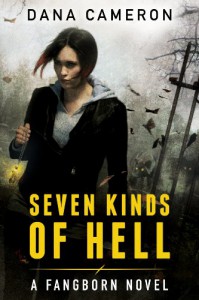
"...it was just my shitty luck that I actually had a secret family full of threatening, dickhead monsters."
Zoe Miller's life has never been television sitcom material. Raised by a single parent, Zoe has been moved from place to place by her anxious mother, never able to settle down, never able to make friends, never able to quell the creeping anxiety that something is hunting her. Zoe's mother hasn't given her many details about her paternal family, but she knows that they're bad news-- and that they're out to get her. But Zoe's greatest fear is a betrayal from her own mind. Since the age of 16, when fearful or threatened, she has experienced a creeping temptation to slip into a personality she calls her Beast: an inhuman, vicious, angry, and clearly insane mentality. Despite it all, Zoe has just managed to piece together an almost normal life for herself. She's made friends, found and lost love, and graduated with a degree in archaeology. But when her mother dies, it all starts to unravel. Mysterious men are following her, the Beast's call is becoming even more strident, and one of her best friends is about to be used as the lure in a trap that Zoe can't help but step into. Since Zoe's only hope is through finding a lost mythological artefact, her archaeological background is about to become unexpectedly relevant.
Seven Kinds of Hell isn't a groundbreaking urban fantasy, but it's a pleasant and enjoyable read. The writing never ascends into lyricism, but it's solid and occasionally sophisticated, and very effective at sucking the reader into the narrative. Zoe is a sympathetic, likeable narrator, and I especially enjoyed the ways in which she brought her knowledge of archaeology into her perspective on the world. My favourite parts of the book were definitely these historical aspects. Cameron has a gift for inserting sly little comments and entertaining tidbits about ancient cultures without breaking the narrative flow. One of my favourites was a description of ancient Greek animal sacrifice: apparently, it was decided that only the bones, hides, and smoke of a sacrifice belonged to the gods, which conveniently left the succulent meat for the hungry worshippers.
The mythology of the world is also tied into the archaeological aspects. As might be guessed by the genre and series name, vampires and werewolves factor heavily into the mythos, but their origins and appearances are somewhat different than the standard tales. Some of the supernatural entities that Zoe encounters supposedly "aren't capable of true evil." As one explains,
"Some call us 'Pandora's Orphans,' the hope that was left in the bottom of the box when the evil was let out. Whatever story you believe, we're the good guys."
These "good guys" are basically vigilantes, brutally murdering anyone they deem to be evil, but they solve this little contradiction by specifying a rather peculiar definition of "evil":
"We can't confuse political manoeuvring with real evil. [X] can be willful or wrong about many things. We can disagree, we can do stupid things...we don't thrive on the unhappiness of others, we don't murder or torture for pleasure, which is how I define evil."
In my opinion, this is a rather inane definition: every wicked man has a justification for his actions, good intentions are all too easily corrupted, and the worst evils come from those who convince themselves they are doing good. While Cameron does touch on this issue, I consider the initial premise so farcical that I was irritated rather than mollified by the simplistic debates. Requiring an entire species to be inherently good also necessitates removing its free will, but that never seems to occur to anyone within the narrative.
The basic plot is a race against time to find an ancient artefact before the rival gangs of bad guys get hold of it, plus a bit of the save-the-hostage game. Through her struggles to save her friends, Zoe is also forced to come to terms with herself. I'm reasonably fond of Indiana Jones/ Tomb-Raider type plots, and, true to the subgenre, Cameron manages to insert quite a bit of absurdist humour. One of my favourite quotes:
"I fell asleep to a German werewolf in a Speedo joyfully singing 'Midnight Train to Georgia' as he steered us over the choppy waves of the Aegean."
While I enjoyed quite a bit of it, the plot quickly devolves into an unintentional Wodehousian farce. Almost all of the action hinges upon a vast concatenation of improbable coincidences, many of which require utterly unnatural actions from a whole set of characters as well as an impressive bit of stupidity on the part of the protagonist. In fact, Zoe is so far past TSTL that I think I'm in need of a new term.*
Every plot can be broken down into a set of tropes, and unfortunately, Seven Kinds of Hell used a few of which I'm less than fond. I'm never big on the "I have your friend"-type situations, because it requires the protagonist to be both incredibly credulous and impressively callous, willing to sacrifice the many for the sake of the one. I can usually tolerate a Hostage-for-McGuffin ploy once in a while, especially if the underlying philosophical conflict is explored, but Cameron actually uses the trope multiple times in one book, mainly as a lazy plot device. Sadly, the story also requires a Chosen One alert, a Friend-or-Idol Decision warning (although Zoe, remaining in character, never bothers with the thinking part), a Dismantled McGuffin notice, and, of course, a truly impressive amount of Contrived Coincidence, to the point where the characters begin wondering if it is all due to Fate. Last, this book definitely isn't intended as a standalone: in fact, much of the plot is left unresolved, a perfect setup for a sequel.
(show spoiler)
At the same time, I really appreciate how Cameron manages to avoid some of the most irritatingly ubiquitous tropes in urban fantasy. First, Zoe is far from isolated: although she starts out as a loner, she quickly develops a large coterie of friends and acquaintances. Second, the romance aspect is kept relatively low-key, and the love triangle is close to nonexistent--at least in this book. While I didn't find Zoe's main love interest to have much of a personality and thought he came across as a bit of a controlling asshole, he definitely isn't an alpha male--another big plus from my perspective. Despite her other forms of idiocy, Zoe is able to keep her mind on her problems rather than her passions, something I really appreciate. Last, for all the many plotholes and coincidences, the book kept me reading. Overall, if you're looking for a lighthearted urban fantasy jaunt with a different slant on the standard supernatural creatures, Seven Kinds of Hell is worth a look.
~~I received this ebook through NetGalley from the publisher, 47North, in exchange for my honest review.~~
*I was irritated enough while reading to propose TFSTFD in my kindle notes.
 19
19
 8
8


